The post Caring for leathers appeared first on FLEMING HOWLAND.
]]>All natural leathers are inherently permeable. As a living material, even when finished, the surface contains microscopic pores that will absorb oils, cosmetics, hair products and any synthetic-based chemicals that come into contact with it. Once absorbed, these substances can migrate through the surface layers and may alter the appearance of the patina over time, creating darkening, patchiness or changes in sheen. For this reason, we advise avoiding direct contact between leather and any non-natural products, particularly on headrests and arm areas where transfer is most likely.
Always protect your furniture from direct sunlight, as this will accelerate the natural on going discolouration process. Never place leather furniture against any heating source such as a radiator. Avoid sitting on the edges of cushions or arms, as this may cause uneven wear and distortion of the padding and leather. Certain non‐colourfast clothing such as denim can stain light coloured leather if it comes into regular contact.
Hand-Coloured leather
Hand-Coloured leathers are hand selected for their natural characteristics. Every hide is different. Because the dyes and finishes penetrate to varying degrees in different parts of the hide, an attractive, variable finish is achieved. Hallmarks such as scars, creases, insect bites and veins add natural beauty and individuality to each hide. Areas of use such as the seat and arm will become lighter in colour. Leather is highly resilient and durable, which over time, will adapt and change, enhancing its appeal.
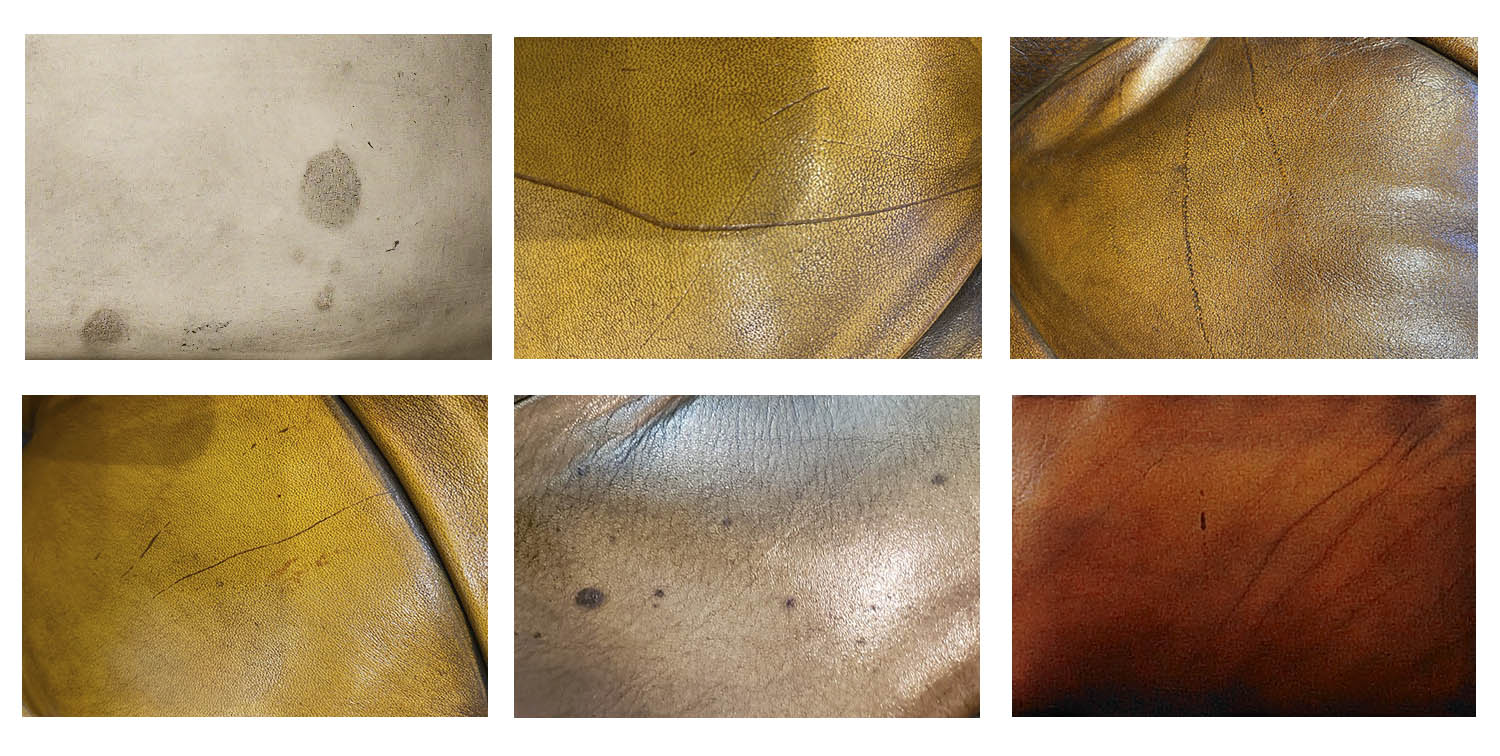
The more subtle markings will feature on more prominent parts of the article although this is not guaranteed. Irregularities in the grain, small scars, insect bites, dung marks and other natural skin marks should not be considered defects. It is perfectly normal for certain areas of the leather such as the pleats to show signs of stretching from new. This will develop naturally during the life of the furniture creating a softer more inviting look, an inherent quality of fine leather furniture.
Throughout the leather hand-colouring process, a series of dyes, sealers, and polishes are applied to age and highlight the distinct patina of each hide. As the final topcoat is applied after upholstery it is not unusual to find some residual colour transfer within areas such as under the folded pleats, inside the deep buttoned holes and other concealed sections not regularly touched or used. As this topcoat is water based, any accidental spillages of liquid may accelerate this colour transfer and therefore it is important to keep your furniture dry. Replacement topcoat in the form of an easy to apply polish is available on request.
Testing & Environment
All furniture is manufactured under the ISO9001:2008 quality system and comply with British / European standards for upholstery leather and the furnishings fire safety regulations 1988. All leathers comply with strict regulations and EU directives covering the use and presence of PCP, CFC, Chromo VI and Azo dyestuffs during the tanning process. All components and materials are from renewable resources and wherever possible British made.
The post Caring for leathers appeared first on FLEMING HOWLAND.
]]>The post Care guide appeared first on FLEMING HOWLAND.
]]>Care requirements vary according to the upholstery material. Select the relevant guide below for advice on routine maintenance, spills, cleaning and the natural characteristics you can expect as your furniture ages.
Leathers
Natural and hand-coloured leathers require relatively little maintenance. Learn how to protect the surface, deal with spills and understand the natural markings, colour variation and patina that develop with use.
Mohair
Mohair velvet is exceptionally durable, with a distinctive pile and lustre that can naturally shade or mark through use. Learn how gentle vacuuming, brushing and occasional steaming can keep the pile looking its best.
Cotton velvet
Cotton velvet has a softer pile and naturally develops subtle shading and pressure marks over time. Our guide explains routine cleaning, pile maintenance and how to deal with spills without damaging the surface.
Wool
Wool is naturally resilient, breathable and resistant to everyday soiling. Regular gentle vacuuming and prompt attention to spills are generally all that is required to keep wool upholstery looking its best.
The post Care guide appeared first on FLEMING HOWLAND.
]]>The post Caring for Mohair and Cotton Velvet Upholstery appeared first on FLEMING HOWLAND.
]]>Routine Maintenance – Gentle Vacuuming & Brushing
Regular maintenance will keep mohair or cotton velvet upholstery looking its best. Vacuum the fabric gently at least once a week using a soft upholstery brush attachment. Always vacuum in the direction of the nap to avoid crushing the fibres. This removes dust and prevents grit from settling into the pile. In addition, brush the velvet occasionally with a soft upholstery brush, again following the direction of the pile. Brushing helps lift the nap, maintains a uniform look, and removes lint or pet hair. Avoid aggressive cleaning tools or harsh scrubbing; a gentle touch is key.
Preserving the Pile – Minimising Marks and Imprints
Mohair and cotton velvet naturally develop crush marks or shading in daily use – for instance, where cushions press against each other or where someone sits for a long period. These marks are normal and generally recover with time and natural humidity. To minimise impressions, avoid leaving heavy objects on the furniture for extended periods. Rotate and plump loose cushions regularly to prevent uneven wear.
If a stubborn crushed area remains, first brush the area softly in the direction of the nap. For more persistent flattening, apply light steam by holding a handheld steamer just above the surface (never pressing down). Immediately follow with brushing in the natural direction of the pile. Use minimal steam – just enough to relax the fibres. Allow the fabric to air-dry fully. Most marks will fade significantly or disappear, restoring the fabric’s lustre. Mohair fibres often recover more quickly, while cotton velvet may need more patience.
Spills & Stains – Blot, Don’t Rub
Both mohair and cotton velvet can be vulnerable to staining if spills are not handled promptly. Always blot immediately with a clean, dry white cloth. Use light pressure and change to a fresh area of cloth as needed. Never rub, as rubbing can flatten the pile and push liquid deeper. Work from the outside of the spill toward the centre to prevent spreading.
For minor spills, plain water on a lightly damp cloth may be used sparingly after blotting. If a residue remains, use a diluted upholstery shampoo or gentle fabric cleaner, but always test on an inconspicuous area first. Apply the cleaner to a cloth rather than directly to the fabric, and dab gently. Avoid harsh chemicals or bleach. After treating, blot with a fresh damp cloth to remove residue, then allow to air-dry fully. Once dry, brush the nap back into place. For oil-based or stubborn stains, consult a professional upholstery cleaner.
Quick Care Guide
- Vacuum weekly with a soft brush attachment, working in the direction of the pile.
- Rotate and plump cushions regularly to reduce pressure marks. Do not leave heavy objects on the fabric.
- Use a soft brush in one direction to lift and settle the nap.
- Lightly steam from a short distance to refresh the pile, then brush gently. Avoid over-wetting.
- Blot spills immediately. Do not rub. Allow to air-dry before brushing.
- Use only gentle upholstery cleaners when needed, tested first on an inconspicuous area.
- Keep velvet away from prolonged direct sunlight to reduce fading.
- Avoid sharp or abrasive objects that could snag or mark the pile.
- Remove pet hair with a soft brush or vacuum attachment.
- Store loose cushions flat. Do not fold velvet sharply.
- Arrange professional cleaning every one to two years to deep clean the fabric and revive the pile.
The post Caring for Mohair and Cotton Velvet Upholstery appeared first on FLEMING HOWLAND.
]]>The post Caring for wool appeared first on FLEMING HOWLAND.
]]>How to care for wool upholstery
Vacuum regularly using a soft brush attachment to remove dust and prevent embedded debris. Promptly blot spills with a clean cloth. Avoid rubbing, and only use mild, wool-safe cleaners. For persistent marks, use a diluted dry-cleaning solution or gentle detergent lightly applied, then allow to air-dry without saturating the fabric. For deep cleaning or delicate cases, professional upholstery cleaning is recommended.
The post Caring for wool appeared first on FLEMING HOWLAND.
]]>The post Disposing of old furniture appeared first on FLEMING HOWLAND.
]]>If you would like your old furniture removed around the time of delivery, you may wish to ask the delivery company whether a separate arrangement is possible when your final delivery is scheduled. Availability and fees can vary, so this would need to be confirmed directly at the time.
If removal is not available, we would recommend recyling first where the item is still suitable, for example by donating, selling, or giving it away locally. If the item is not suitable for reuse, your local authority or city may offer a bulky-waste collection service, or you may be able to take it to a local recycling or transfer facility. A licensed private removal service may also be an option where local services are not suitable.
The post Disposing of old furniture appeared first on FLEMING HOWLAND.
]]>The post Service centres appeared first on FLEMING HOWLAND.
]]>Our approach to aftercare is guided by restraint. Repairs are undertaken with the intention of preserving what already exists. This includes retaining patina where possible, restoring structure where necessary, and ensuring that any intervention sits seamlessly within the life of the piece. From the re-tensioning of springs to the careful reinstatement of hand-finished leather, each detail is handled with the same discipline as the original making.
This network offers reassurance to those who live with our furniture across the world. It ensures that, wherever a Fleming Howland resides, it can be maintained with continuity and care, allowing it to evolve gracefully over time, and to remain a lasting part of the interiors it inhabits. Availability varies by location, article, material and the nature of the work required. Any inspection, service or remedial work must be arranged or approved by Fleming Howland in advance.
To locate a Fleming Howland Service Centre near you, please visit our contact page and explore the directory.
The post Service centres appeared first on FLEMING HOWLAND.
]]>The post Product registration appeared first on FLEMING HOWLAND.
]]>Client order details are archived for future reference. The factory collaborates with a worldwide network of approved service centres meaning clients around the globe can be assured that a local professional is available to perform any required work or repairs.
REGISTER
The post Product registration appeared first on FLEMING HOWLAND.
]]>The post Understanding the cushion exchange program appeared first on FLEMING HOWLAND.
]]>The Cushion Exchange Programme reflects Fleming Howland’s commitment to enduring comfort as well as craft. For customers who find the initial feel of their sofa or chair cushions different from expectation, the programme offers an exchange of fillings to achieve the preferred level of softness or firmness.
Eligibility and Process
Once the furniture has been delivered, customers may request an exchange within the first 60 days if they wish to adjust cushion comfort. It is important to note that certain fillings require time to settle: they may feel firm when fresh from the factory but will gradually ease with regular use. For this reason, customers are encouraged to live with the furniture for several weeks before making a request. Unless Fleming Howland advises otherwise, there is no need to return the original set; replacement cushion fillings will be supplied in the selected comfort option. To begin the process, customers should provide their order number along with details of the preferred filling.
Limitations and Conditions
The programme applies only to qualifying removable cushion fillings and is limited to two filling exchanges within 60 days of delivery. It does not apply to fixed upholstery, frames, covers, decorative detailing, non-removable seats, bespoke comfort constructions or other elements of the furniture. Where an order is outside the United Kingdom, any local duties, taxes, customs charges or handling costs connected with replacement fillings may remain the customer’s responsibility unless Fleming Howland agrees otherwise in writing.
The programme is subject to our Terms and Conditions.
The post Understanding the cushion exchange program appeared first on FLEMING HOWLAND.
]]>The post Understanding Production Delays appeared first on FLEMING HOWLAND.
]]>When an order is placed with Fleming Howland, it is scheduled for completion based on the estimated timelines provided at the time of purchase. These dates are intended as a guide only and are not directly linked to live production. As each item is made to order, timings can vary depending on the materials, processes, and level of detailing required.
Material Sourcing
Many of the materials used such as leather hides and natural fabrics are subject to limited supply and longer lead times. Sourcing delays can therefore affect overall production schedules.
Craftsmanship Adjustments
Each item undergoes multiple stages of craftsmanship. Occasionally, refinements are required during upholstery or finishing to ensure the highest standards are achieved. These adjustments, while extending lead time, are essential to delivering the correct result.
Quality Control
Before dispatch, all items are subject to thorough quality control checks. If any element requires reworking, additional time is allocated. This is always prioritised over speed to ensure durability and consistency.
Customisation Requests
When customers request bespoke modifications, extra time may be required for design, material preparation, or prototyping. These additions are factored into the production schedule but can lengthen the overall timeline.
Impact of National Holidays
Factory closures during national holidays temporarily pause production. These closures are outside the company’s control and may extend the expected completion date. Work resumes as soon as operations reopen.
Communication and Updates
Customers are encouraged to contact Fleming Howland for updates at any stage. The company provides the most accurate information available, with confirmation once production is complete and the order is ready for dispatch.
The post Understanding Production Delays appeared first on FLEMING HOWLAND.
]]>The post Wear and tear appeared first on FLEMING HOWLAND.
]]>Where a valid structural frame claim is accepted under the guarantee, Fleming Howland will arrange an appropriate remedy. For issues outside the guarantee, Fleming Howland will still seek to assist where practical, usually by offering paid servicing, replacement components or specialist repair advice.
What is not covered by the guarantee
The guarantee does not cover wear and tear or product damage caused by misuse, negligence, or accident. This includes but is not limited to damage caused by:
- Extensive use.
- Abuse of product.
- Damage caused by chemicals.
- Disregard for the product care or cleaning instructions.
- Stains caused by food, ink, bleach, sunscreen, zinc, chlorine, etc.
- Damage caused by animals.
- Third-party alterations made to the product.
The definition of ‘wear and tear’
Fleming Howland furniture is built to last but keep in mind that external pressure, elements and chemicals will have an effect on natural materials. Over time, colour pigments may change within the fabric or leather, often lightening in tone and colour. The pleats around the deep buttoning may soften and open up, especially in areas of use. Button caps may become loose or caught and seat cushions may become out of shape due to filling compression and material elasticity. These are examples of normal wear and tear, not defective workmanship or materials.
Repairing damage not covered by the guarantee
We will do our best to repair these items at a cost proportionate to the extent of the damage. Fleming Howland reserves the right to determine if the repair is possible and what the associated cost will be. Repair costs must be paid in full before repairs are completed.
Troubleshooting
In case of damage, whether it be through an accident or wear and tear, we will always offer to support our customers by supplying the necessary components and materials to work alongside your insurance or repair company. To help us identify the issue please complete the troubleshooting form.
TROUBLESHOOTING FORMThe post Wear and tear appeared first on FLEMING HOWLAND.
]]>The post Replacements and repairs appeared first on FLEMING HOWLAND.
]]>Cushion covers
As time passes and with regular use, the colours and dimensions of your cushion covers may change, depending on the type of upholstery material. To ensure the best possible fit and appearance, we kindly request that our clients send their cushion covers to our factory for inspection. When sending the covers, please remove the filling and simply roll up the cover, protecting it with appropriate packaging material. This will allow us to accurately pattern any replacement covers, guaranteeing a perfect fit.
Upon receiving your covers, our team will assess whether the entire cover or just the cushion top needs to be replaced. You will also have the option to decide if you would like to replace the cushion filling. Once the inspection is complete, we will provide you with a quotation for your approval before proceeding with any work.
Cushion filling consistency
All seat cushions produced by Fleming Howland are pre-fabricated under strict quality controls. Each cushion is filled with the exact same amount of stuffing and assembled in the same way. This process ensures consistency and prevents variation between cushions.
Why cushions appear different
Photographs may suggest that one cushion is less filled than another, but this is usually a result of use rather than manufacture. When a cushion is sat on more frequently, the filling responds to the body’s weight and movement, gradually altering its surface shape. This can create the impression of uneven stuffing, even though all cushions contain identical amounts.
Normal behaviour of loose cushions
This type of wear is typical for all sofas with loose cushions, not just Fleming Howland products. Fillings are designed to adapt to the forces placed upon them, which means cushions will settle differently depending on how they are used.
How to maintain a uniform appearance
To achieve a more even aesthetic, it is recommended that customers rotate or sit evenly across all cushions. This allows the fillings to settle consistently over time and helps maintain a balanced look across the entire sofa.
Over time, cushion fillings made from fibre or foam gradually lose their elasticity. Because this change happens slowly, it often goes unnoticed. The longevity of feather fillings, on the other hand, rely entirely on the air that’s manually fluffed into them. As a natural material, feathers will slowly deteriorate, typically within 8–10 years of regular use.
If you’re considering replacing your cushion fillings, we strongly recommend sending us your existing cushion covers for professional fitting. With regular use, covers can stretch or change shape, and adjustments to stitching or reshaping may be needed to ensure a proper fit. Should any alterations be necessary, we will always inform you beforehand and seek your approval before proceeding.
Re-upholstering an existing item
Re-upholstering an existing piece is often far more complex than it appears. Once a sofa or chair arrives at the workshop, every layer must be carefully stripped back, the frame assessed and cleaned, and a completely new pattern cut and upholstered, essentially replicating the full making process without the efficiencies of building from new. When combined with the cost of collection and redelivery, the labour and material investment quickly becomes prohibitive.
For most clients, the total expense exceeds the price of commissioning a new made-to-order piece, crafted to the exact specification and comfort profile required. For this reason, Fleming Howland generally advises commissioning a fresh build rather than re-upholstering an existing item, ensuring greater value, longevity and design integrity.
Troubleshooting form
Only furniture that has been purchased from Fleming Howland can be serviced. In order to assess the problem please complete this short form. If your items are from a different manufacturer please contact them directly for advice or get in touch with a local upholsterer.
TROUBLESHOOTING FORMThe post Replacements and repairs appeared first on FLEMING HOWLAND.
]]>The post Checking goods on delivery appeared first on FLEMING HOWLAND.
]]>1. Inspect the packaging
Before the furniture is moved into position, please look over the outer packaging for any obvious impact, tear, puncture, crushing or other unusual mark.
2. Note any visible concern
If the packaging appears damaged, please make a clear note on the delivery document before signing. Where possible, ask the driver to acknowledge or sign the note.
Please use clear wording such as:
“Packaging marked on arrival. Further inspection required.”
3. Photograph the concern
If there is a visible concern, photographs are extremely helpful. Where safe and practical, please photograph the relevant packaging before it is removed, together with wider images showing the full package. After unpacking, photograph the corresponding area of the furniture.
4. Check the furniture
Once unpacked, inspect the furniture in normal light. Leather, timber and fabric are natural materials and may display individual characteristics, so if you are unsure whether something is part of the material or a delivery-related mark, please photograph it and contact Fleming Howland before attempting any treatment.
Please report any visible delivery concern within 48 hours of receipt. This timing helps us protect the transit insurance position and arrange the quickest resolution.
5. Retain the packaging
Please keep any relevant packaging until Fleming Howland has reviewed the photographs and advised the next step. Packaging can help establish what occurred during transit and may be required for a carrier or insurance assessment.
6. If the concern appears limited
If the concern appears limited to the packaging or to a surface issue which can safely be assessed after delivery, accepting the furniture where practical allows Fleming Howland to inspect the matter and arrange the most appropriate professional response with minimal disruption.
Depending on the material and nature of the concern, this may include professional reconditioning, recolouring, repair, replacement of an affected leather or fabric panel, replacement of a component, or another appropriate remedy.
7. If access is different from expected
If the delivery route requires an unusual or previously unapproved manoeuvre, including above-head lifting, movement over walls or gates, hoisting, deglazing, door removal or other specialist handling, please allow the delivery team to stop and contact Fleming Howland.
A difficult or unsafe manoeuvre should not be attempted simply to complete the delivery on the day. Alternative arrangements can then be assessed and agreed.
8. Submit your report
Please send your report to Fleming Howland as soon as possible and ideally within 48 hours of receipt, including where available:
- Your order number
- A brief description of the concern
- Photographs of any relevant packaging
- Photographs of the affected area of the furniture
- Wider photographs showing the article as a whole
- A copy or photograph of the marked delivery note, where available
Each case will be reviewed on its individual circumstances. Once assessed, Fleming Howland will advise the appropriate next step.
Hand-Coloured Leather
Fleming Howland Hand-Coloured Leather has an individually applied surface finish designed to support professional reconditioning, blending and recolouring during the life of the furniture.
Natural grain, healed scars, tonal variation and surface character are part of the individuality of the hide. Light surface colour movement or rubbing can often be professionally restored without damage to the underlying leather. If you are unsure about a mark, please contact us before applying polish, dye, conditioner, heat or another treatment.
Pressure marks from packaging
Soft upholstery can show temporary pressure impressions following transportation. Mohair and velvet may also display pile movement, shading or bruising after being wrapped. These effects are normally superficial and often relax naturally once unpacked and allowed to settle in a normal room environment.
Please refer to our care guide for further advice, or contact Fleming Howland before attempting treatment.
Important note
If receipt is signed without noting visible packaging damage, it may be more difficult to support a transit insurance claim. Please inspect the packaging carefully, record any visible concern on the delivery document where possible and contact Fleming Howland promptly if assistance is required.
These steps are designed to help us investigate delivery concerns efficiently and provide the most appropriate professional response. Nothing in this guidance limits any rights which cannot lawfully be excluded or restricted.
The post Checking goods on delivery appeared first on FLEMING HOWLAND.
]]>The post Promises and guarantees appeared first on FLEMING HOWLAND.
]]>Our Promise
A Fleming Howland piece is a considered investment, handmade in Lancashire using enduring materials, traditional upholstery skills and long-established British craftsmanship.
Whether you are ordering from the United Kingdom or overseas, your commission is handled with care from the first enquiry to final delivery. Your specification is confirmed clearly, your payment is processed securely, and your furniture is supported by experienced aftercare.
We understand that many clients order from a distance. Our role is to make that process feel informed, secure and reassuring.
Confidence from quotation to delivery
Every Fleming Howland order is managed with clear communication and careful documentation. Before production begins, your chosen model, dimensions, upholstery, leather or fabric, colour, filling, finish and delivery details are confirmed so that your furniture can be made to the agreed specification. Our team remains available throughout the process, offering guidance on materials, comfort, access, care and delivery planning.
Comfort support
Comfort is personal. For qualifying designs with removable cushion fillings, our Cushion Exchange Programme allows you to request a softer or firmer filling within 60 days of delivery. This gives you time to live with your furniture and refine the seat comfort where the design allows.
Structural guarantee
Fleming Howland furniture is built around solid internal frames and traditional upholstery methods. Our structural frame guarantee covers the internal frame for 20 years in domestic use and 10 years in average commercial use.
Long-term aftercare
Fleming Howland furniture is made for long ownership. After delivery, our team can advise on care, servicing, cushion interiors, replacement components, restoration and specialist support where appropriate. Through selected independent service specialists, we can help preserve the comfort, structure and character of Fleming Howland furniture over time.
All promises and guarantees are provided in accordance with our Terms and Conditions. Your statutory rights remain unaffected.
The post Promises and guarantees appeared first on FLEMING HOWLAND.
]]>